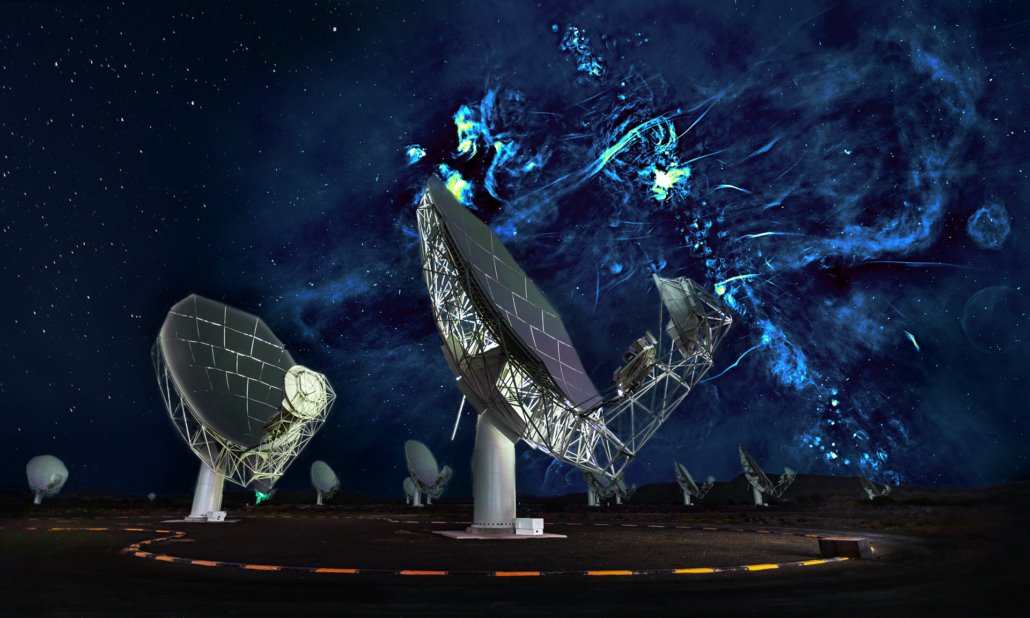
A team of international astronomers has made a serendipitous discovery of 49 new gas-rich galaxies, thanks to the South African-based radio telescope, MeerKAT. The observations were made possible by Inter-University Institute for Data Intensive Astronomy (IDIA). The research was published in a Monthly Notices of the Royal Astronomical Society.
Star-Forming Gas
The MeerKAT telescope is operated by the South African (SA) Radio Astronomy Observatory, which is a facility of the National Research Foundation (NRF), an agency of the Department of Science and Innovation (DSI). According to the astronomers, to date this is the first reported discovery in an observation not intending to search for such galaxies in the first place.
The team was led by Dr Marcin Glowacki, from the Curtin University node of the International Centre for Radio Astronomy Research (ICRAR) in Western Australia. It aimed to study the star-forming gas in a single radio galaxy. The team didn’t find any star-forming gas in the galaxy they were studying, but Dr Glowacki made a discovery of other galaxies while inspecting the data. In total, the gas of 49 galaxies was detected, said Dr Glowacki, adding this demonstrates how crucial an instrument like MeerKAT is for finding the star-forming gas in galaxies.
Episodic Mergers
Galaxy systems, according to astronomers, form through episodic mergers with groups thought to act as building blocks for the more massive clusters. Groups number between 3 and 100 members within a dark matter halo of mass between 1012 and 1014 M⊙. “I did not expect to find almost fifty new galaxies in such a short time. By implementing different techniques for finding galaxies, which are used for other MeerKAT surveys, we were able to detect all of these galaxies and reveal their gas content,” Dr Glowacki said.
Gold rush miners
The new galaxies have been informally nicknamed the 49ers – a reference to the 1849 California gold rush miners. Dr Glowacki views the 49 new galaxies as valuable as gold nuggets in our night sky. Many galaxies are near each other, forming galaxy groups, with several identified in one observation. Three galaxies, in particular, are directly connected by their gas. “These three are particularly interesting, as by studying the galaxies at other wavelengths of light, we discovered the central galaxy is forming many stars. It is likely stealing the gas from its companion galaxies to fuel its star formation, which may lead the other two to become inactive,” said Dr Glowacki.
Power of MeerKAT Telescope
The University of the Western Cape’s Professor Ed Elson, who also co-authored the paper, pointed out the significance of the MeerKAT telescope. “This discovery highlights the raw power of the MeerKAT telescope as an imaging instrument. The methods we developed and implemented to study the 49ers will be useful for MeerKAT large science surveys and smaller observing campaigns such as ours,” he said.
The discovery also opened other observations. Recently, Jasmine White, an ICRAR summer student working with Dr Glowacki, was able to discover even more gas-rich galaxies in other short observations made by MeerKAT. “We hope to continue our studies and share even more discoveries of new gas-rich galaxies with the wider community soon,” concluded Dr Glowacki.

Hidden gas-rich galaxy found by MEERKat (Image: SARAO)