October has become synonymous with a sensitivity around mental health issues and orchestrated attempts to reach out to those burdened with the strain of work, financial, and personal pressure.
But towards the end of 2021, we find ourselves in an altered world, where reaching out has become a bit of a dilemma.
What we perhaps need now is to go back to the drawing board. And start with one.
Social distancing seems to be the exact opposite of social outreach. It seems to imply withdrawing a hand instead of extending it; staying static instead of going out; soaking up support and advice instead of selflessly sharing it. So, how on earth do we reach out to people under these circumstances?
Effects of isolation
One of the great and sad ironies of the COVID-19 pandemic is that it has not really resulted in the overriding sense of community and solidarity that often accompanies severe communal hardship. Normally, there is nothing that unites people like a common adversary. But even though we are faced with a situation that affects absolutely all of us, so many people have never felt so isolated as now.
We are all in the same boat. Yet many people constantly feel as if they are drifting alone on their own little life rafts, just hoping to survive as they desperately try to ride out the storm.
Psychologists on our campuses report that they are seeing more students than ever before, as more of them seem to muster up the courage to attend an online counselling session – which some find less daunting than a face-to-face consultation. And while it is encouraging to note that those in need are indeed making use of the services on offer, these virtual interactions have their own challenges and limitations. Counsellors find it difficult to read patients’ body language and to gauge aura and atmosphere. It is often hard to reach out and connect with someone who is not near you.
Our limited and restricted interactions seem to worsen the isolation. Although we are down to alert Level 1 in terms of lockdown regulations, many individuals and workplaces are still cautiously – and wisely – limiting social interaction as far as possible. We don’t just bump into colleagues and acquaintances in passages and at meetings anymore. And if we do see someone, our masked faces often expose little about how we really feel. Social media profiles similarly reveal very little, often displaying smiling, positive images that may be deceptive – not to mention several years old.
Deliberately reaching out
I believe what we need now is to deliberately reach out to those around us. We simply can no longer rely on chance encounters to find out how people are really doing. And when we do reach out, our interactions need to be deeper than just the superficial enquiries about physical health. Our concern needs to stretch further than just wanting to know if those around us are physically surviving this pandemic. We need to be sensitive enough to pick up whether they are coping under the huge mental strain that fear and uncertainty can bring. And we need to offer genuine care and support if they don’t.
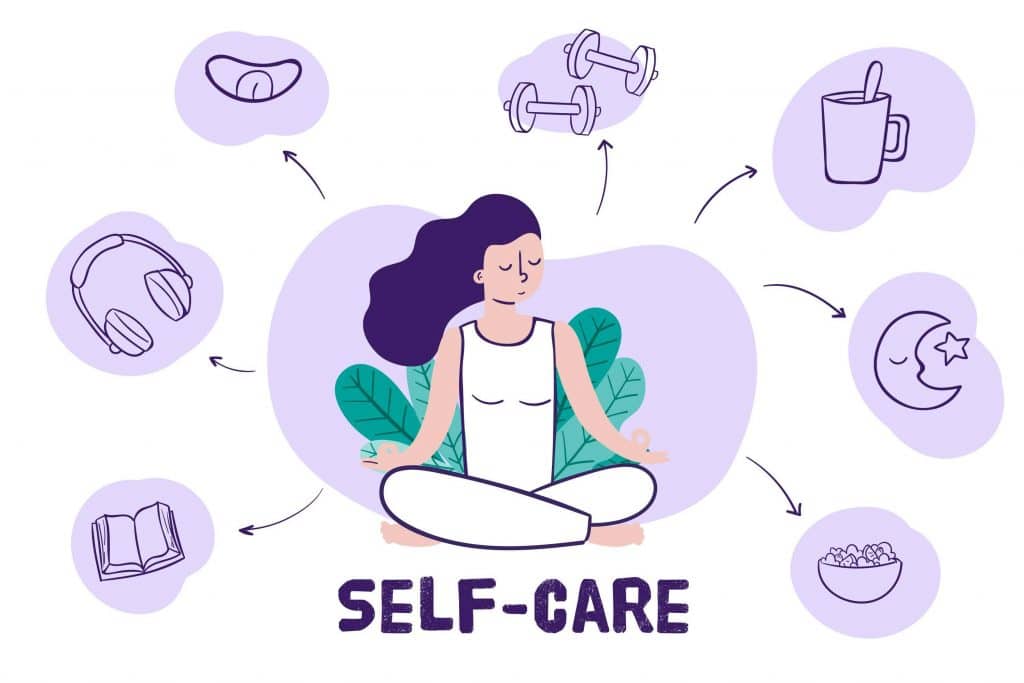
It starts with self-care. The old adage that you ‘can’t pour from an empty cup’ remains true. We need to look after our own physical and mental well-being first.
Institutional self-care needed
Institutions need to do systemic self-care too. We need to have risk strategies and measures in place to make sure that we survive the ramifications of this pandemic. And once that is in place, we urgently need to take care of our employees.
At the University of the Free State (UFS), we have started a comprehensive, integrated effort to look after the health and wellness of our staff as well as our students. Programmes have been put in place to monitor and evaluate mental-health needs, and interventions that are carefully designed to address them. Self-care workshops, podcasts, and webinars frankly address issues such as ‘loneliness and working from home’, ‘building resilience’, and ‘managing fatigue’.
I believe that in the current climate, initiatives such as these should no longer be seen as extra add-ons offered benevolently by employers; it should be viewed as equally essential as a pay cheque at the end of the month.
As institutions, we are continuously pre-occupied with how we can serve the masses. Programmes and policies are developed to apply to all. But from time to time, we must also be able to reach out to the one. We need to be able to cater for those individuals at risk of falling through the cracks.
At the UFS, we launched the No Student Left Behind campaign at the beginning of the pandemic to ensure that all our students were able to make use of online teaching and learning facilities to complete the academic year.
And here lies another bit of irony – this time in a positive sense: Technology has actually enabled us to be more personal. Using advanced data analytics, we can pick up patterns in how students use our online learning offerings, enabling us to zoom in on those who are not regularly logging in and may need individual attention and assistance. We can identify what they are struggling with and help them – one by one.
One person is all it takes
To me, the ‘value of one’ is poignantly and heart-warmingly illustrated through the ‘Khothatsa Project’ (derived from the Sesotho word meaning ‘to inspire’), initiated by our Centre for Teaching and Learning. Students were invited to write about how individual lecturers inspired them, to which the lecturers replied with a letter of their own.
Small, personal exchanges in the form of old-fashioned communication. One lecturer, one student.
It once again proved how one small act of kindness and recognition can spread much wider than initially intended. Because in the end, these stories were put together in a publication, shared on online platforms, and now serve as inspiration for many students and lecturers, as well as a wider readership – many of whom are yearning for this kind of personal exchange.
Lea Koenig, a now retired lecturer in Extended Programmes offered on our Qwaqwa Campus, accurately sums it up in her foreword to the publication:
“To connect with another human being on a cognitive and emotional level leaves permanent, healing change. This is transformation of the purest kind. I am proud to be part of an institution that can showcase these relationships and the change it brings in our lives, but also the huge potential to change the world.”
Lea’s words and the entire Khothatsa Project once again reminded me of the immense potential and saving power that lies in sincere one-on-one interaction. And maybe this is how we should approach Mental Health Month this year. As an opportunity to really reach out and get involved with at least one person who is taking strain.
After all, a drowning victim does not have much need for a shower of virtual well-wishes and a stream of sympathetic words. He/she needs something tangible. Something close and real – a real-life life buoy.
And normally, one is enough.