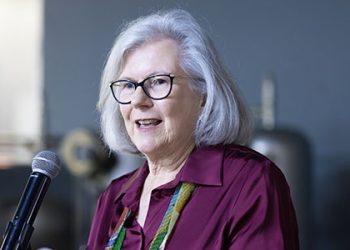
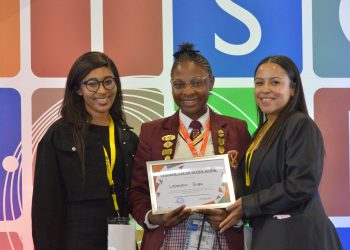
The World Bank’s (WB) Country Director, Marie Francoise Marie-Nelly, warns that if the situation of female under-representation in Science, Technology, Engineering and Mathematics (STEM) fields in Sub-Saharan Africa (SSA) does not change, women will remain in jobs likely to be replaced by technology, are lower paying or less economically impactful. More African females must get into STEM.
In an opinion piece for the WB, she highlights her experiences since moving to southern Africa in 2019 and why it is necessary to ensure more girls in Africa get into STEM. Marie-Kelly recounts meeting many impressive women working in (STEM) related fields and also an inspiring group of young women, pursuing non-traditional careers for women such as aircraft pilots, physicians, electrical engineers and computer programmers.
She mentions South Africa’s Dr Quarraisha Abdool Karim, a globally renowned scientist at the forefront of research and innovation in HIV/AIDS, worldwide and Botswana’s Captain Kgomotso Phatsima, who started her career in the military and is CEO and founder of the Dare to Dream Foundation which advances women’s empowerment of young women in aviation and aerospace. She also refers to two other South Africans, Dr Lindiwe Sidali, the first female cardiothoracic surgeon and Baratang Miya, a self-taught coder and founder of GirlHype, which provides programming and app development training for girls and young women.
Despite the stellar careers of these women, there is still a gross under-representation of women in the STEM fields in SSA (see table at end of article), the share of females graduating from tertiary education is below 30% for many SSA countries. As a result, scientific work and technological innovation are missing women’s invaluable perspectives and critical contributions. This also means that most women will remain in jobs that are likely to be replaced by technology, lower paying or less economically impactful in an increasingly technology-driven world as shown in a UNESCO Science Report: Towards 2030.
More African Women Must Get Into STEM
Existing data shows that globally, there is a “leaky pipeline” leading to far too few women in STEM careers and southern Africa is no different. In the case of Botswana, Eswatini, Namibia and SA, girls’ secondary education enrolment is higher than for boys, but many of them drop out before completing their secondary education. Of those who complete secondary education, many lack the required proficiencies in numeracy, science and the digital skills required to enrol or excel in STEM related programs at this level. In SA more girls than boys achieved 30% or higher in mathematics in the National Senior Certificate Examination (Matric). In the Eswatini General Certificate of Secondary Education, boys outperformed girls in mathematics and science.
The Equality Equation Report found that gender norms, stereotypes, biases and sexual harassment were key drivers of low representation of women in male-dominated STEM fields. Gender biases and expectations for different genders, set by families, society, culture and the media tend to propagate stereotypes, discriminatory practices and policies which deter girls from pursuing STEM careers and also lead to women leaving these careers. These challenges limit the chances of girls’ exposure to these fields, which in turn discourage more girls from pursuing STEM careers; creating a vicious circle that must be disrupted!
What can be done to change the status quo?
The good news is that some of these key drivers of gender disparities in STEM fields are known and are solvable. Moreover, there is no lack of innovative initiatives across Africa targeting some of these root causes. We need to scale up interventions that have proved to be game changers. Some of these focus on improving access to and quality of pre-tertiary education to ensure students, both girls and boys, are learning and acquiring the expected competencies in math, science, literacy and digital skills.
These interventions focus on incorporating gender-responsive and integrated STEM education in pre-tertiary education curricula, providing mentorship and hands-on-training opportunities for girls and young women in collaboration with STEM industries, while and promoting flexible and family-friendly workplace policies.
At the WB, we are committed to strengthening STEM education, especially as it pertains to girls and young women. In Lesotho, we are supporting the Government to strengthen teaching and learning in mathematics and science in junior secondary education through an innovative, technology-driven largely open-source solution, providing access to high quality, interactive and fun materials for students to learn these subjects. We believe that students will gain an appreciation for science and mathematics if it is taught in an engaging environment filled with lively debate and collaborative problem solving.