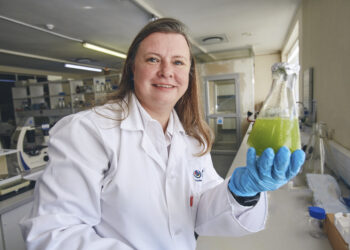
DR LUCIA STEENKAMP
Most people are well aware by now of the precarious state of the natural environment. We urgently need to find new mechanisms and technologies to produce commodities that will not harm the environment. This is one of the reasons I find my work in green chemistry and biocatalysis so worthwhile.
Biocatalysis uses living enzymes and microorganisms to speed up chemical reactions in manufacturing processes. People may not realise it, but the beer that they drink is made using microorganisms that turn sugar into alcohol, making it part of the biocatalysis sector. These days enzymes have many applications in industry. Among other things, they are used in laundry soaps to remove stubborn stains, and to give designer jeans their bleached appearance.
Technologies developed using biocatalysis are less harmful to the environment, and also use less energy, as reactions take place at close to ambient temperatures. Although biocatalysis on a commercial scale is still very new in South Africa, the industry partners that I work with are passionate about responsible manufacturing and the use of green technologies. My team and I are proud to partner with companies like Clive Teubes Africa, one of the largest distributors of citrus and essential oils and isolates across the globe; Puris Natural Aroma Chemicals, a South African aroma chemical producer; Biodx Biological Chemical Technologies, a research and development company focusing on developing innovative, cost-effective antimicrobial control technologies based on a natural citrus extract; and Chemical Process Technologies, a supplier of expressed animal health products.
We have worked with Biodx to produce two biocides (a chemical substance intended to destroy, deter, render harmless, or exert a controlling effect on any harmful organism) and the company is already producing the products at ton scale, while also awaiting the final registration of the products in Europe. A number of biocatalysis-related technologies were developed for Clive Teubes Africa, which has registered the first BBBEE company in the flavours and fragrance industry to commercialise the technologies. Technologies were also developed for Puris for four different flavour products, which have been scheduled for commercialisation in January 2020 (the company is currently using its bio-fermentation facilities for another product). Technology development for Chemical Process Technologies is still in progress.
Developing a bioeconomy for SA is of vital importance as it will lead to clean, environmentally friendly products that promote health, wealth and well-being. The advancement of green chemistry and biocatalysis in our country will lead to the creation of a significant number of new job opportunities. It will be important to teach learners about green technologies and give them the new skills that will be required for the bioeconomy. A number of sectors can employ biocatalysis and green chemistry, including the pharmaceuticals and veterinary, flavours and fragrances, food and beverages, and medical diagnostics.
*Dr Lucia Steenkamp is a Principal Researcher in the Chemicals Cluster at the CSIR. In 2018 she was the winner in the SA Women in Science Awards Distinguished Women Scientists – Research and Innovation category for work on green technologies and biocatalysis for external industry partners.