


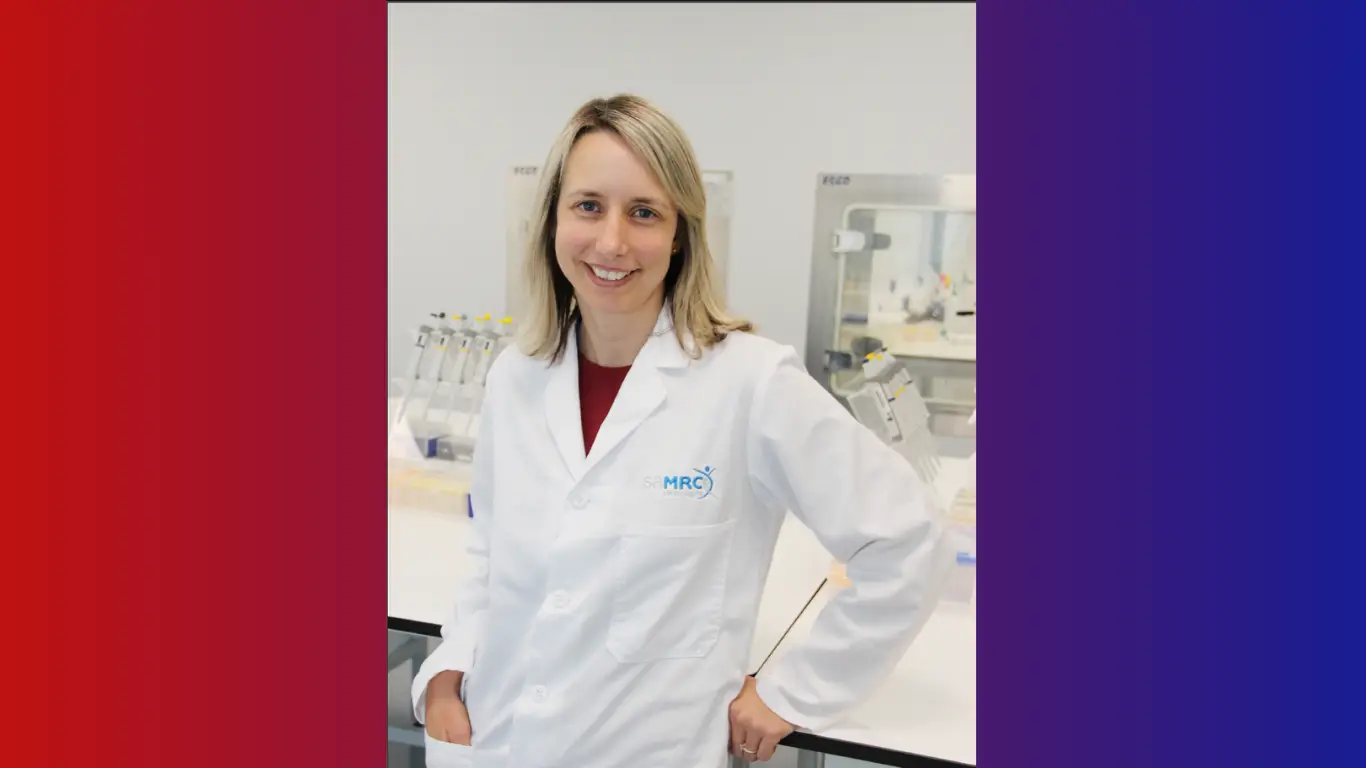
Dr Nadia Carstens
From doing little experiments in the family garden to being a specialist geneticist
Young Nadia Carstens loved playing with her brothers and cousins in the family’s lush back garden. One of their favourite pastimes then was doing little experiments; gathering little containers and filling them with squashed plants, bugs and whatever they could lay their hands on from the kitchen. “I loved these experiments!”, she says.
HPSCA registered specialist
Today, Dr Carstens is an accomplished HPCSA-registered medical specialist in the field of medical genetics. She is a specialist scientist at the South African Medical Research Council (SAMRC) Genomics Platform. In addition, she holds an honorary appointment as researcher at the University of the Witwatersrand. At school she enjoyed biology but only got exposed to the range of medical science careers at an university open day while in Grade 12. “Many of the biological sciences were experiencing a boom at the time due to emerging and rapidly accelerating technologies. The idea that I could be a part of the next technology wave that would revolutionise medicine really moved me,” says Dr Carstens.
Genomics revolution
During her third year of her BSc undergraduate degree, she was drawn to genetics largely because she wanted to be part of the excitement generated by the start of the genomics revolution. “All organisms have a genetic blueprint which offers so many opportunities for research and real impact (and a wide range of career paths). The first human genome was released during this time and I was just fascinated by the promise that it held for modern medicine,” explains Dr Carstens.
Rare development disorders
Dr Carstens says medical scientists play a vital role in evidence-based medicine and technological advancements to improve treatments, disease diagnostics and pathogen surveillance. Regarding her current role and responsibilities, Dr Carstens says she specialises in a technique called next-generation sequencing (NGS). “This technology allows us to analyse the genetic material of any organism. I help other scientists and clinicians to incorporate this technology into their work as part of my role at the SAMRC Genomics Platform and I use this technology for my own research on rare developmental disorders as part of my role at Wits,” she says.
Genetic diagnostics
Dr Carstens loves her work because she gets to collaborate with and learn from so many talented scientists and clinicians from around the globe. She also works hard to advance her field, for instance, she leads and contributes to a lot of local and international multi-disciplinary projects that use NGS-based approaches to improve genetic diagnostics in patients of African ancestry.
Says Dr Carstens: “My first assay development project, an inherited diseases NGS panel, was implemented into the clinical service of the Division of Human Genetics (NHLS or Wits) in 2021. More than 300 research findings from my current and past rare disease projects have been communicated to the relevant patient’s referring clinician with a positive impact on clinical decision making and care.”
Proudest moments
Of all the projects she was involved in, Dr Carstens singled out the NICU Exomes study that she leads, as one she is particularly proud of. The study recently published its first paper to show that NGS-based testing can significantly improve diagnostic testing for genetic disorders in NICUs and PICUs within the South African State healthcare system.
She is also proud of the SAMRC Genomics Platform’s Exome Diagnostics Development Initiative through which they successfully managed to bring down exome sequencing cost to R3 000 per sample with this development project. “This is a real game changer for South African researchers who are used to paying double this amount locally. More researchers and clinicians will now be able to incorporate this into their research and clinics, a win for genomic medicine,” argues Dr Carstens.
Building next pool of genomics scientists
To contribute and build a next generation of genomics scientists, she ensures she incorporates trainees, post-graduate and interns are accommodated into every possible space in the research and NGS services. Some of the challenges she encountered in the course of her work include striking a fine balance between her family and work commitments. But fortunately for her she has a loving and understanding husband, and a supportive team.
Encouraging more women to enter the STEM field
Dr Carstens strongly believes that more women should be supported to enter the STEM field which is currently still dominated by men. “As a mother of two little girls, I think a lot about gender bias in early development. We can do more as a society, parents and educators to steer girls towards STEM fields,” says Dr Carstens.
She says there is already a big improvement in her girls’ generation compared to her own, adding “we are now more conscious as a society to break down career gender stereotypes and showcase representative role models, for example. Let’s continue the dialogues and engagements and change what we can to spark early interest and equip more girls pursue careers in STEM”. She says more programmes are needed to encourage girls to choose and enjoy STEM-related subjects in schools, particularly in underprivileged settings. “Many girls are losing out on important early opportunities to build the educational foundation needed for a career in STEM,” she adds.
Future ambitions and legacy
Regarding her future goals and aspirations, Dr Carstens says her wish is to “build local and regional pocket of excellence for genetic sequencing technology. We have so much local talent and we need to challenge historic attitudes that technological advancements come from overseas”, she observes. In terms of her legacy, Dr Carstens says she would like to play a key role in helping to advance precision and genomic medicine in South Africa. Furthermore, “I hope to inspire more South African women in STEM to embrace new technologies as developers and not just end users. We can lead technological advancements,” she concludes.
Links to Dr Carstens academic work:

