


Paarl Africa Underground Laboratory (PAUL) accessed via the existing Huguenot tunnel
The physics and science community in Africa is realising its dream of a local underground laboratory. It was officially launched after a week-long international science in the Western Cape last week. The laboratory, the continent’s first deep underground laboratory, will be established in the Du Toits Kloof Mountains (Paarl Mountains) in the Western Cape in South Africa (SA) and will be accessed via the existing Huguenot tunnel.
PAUL is a Game Changer
The Paarl Africa Underground Laboratory (PAUL) will be established in an underground laboratory with a floor space of about 600 square metres and a total volume of 10240 cubic metres that took a decade to plan. Many such underground laboratories are already functioning in Asia, across Europe and North America. The four-kilometre-long road tunnel (800m) will be the longest road tunnel in SA, and managed by the SA National Roads Agency Limited (SANRAL). Professor Sibusiso Moyo, deputy vice-chancellor of Research, Innovation and Postgraduate Studies at the Stellenbosch University (SU), said the laboratory, once fully implemented, will be a game changer for universities, not only in the Western Cape and SA, but for all its partners in Africa.

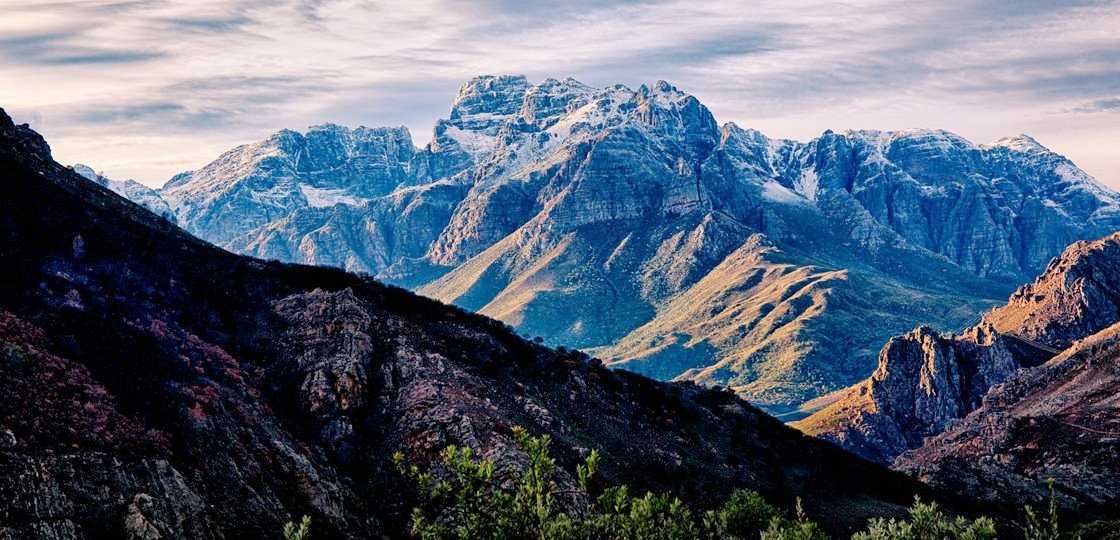
Du Toits Kloof Mountains in Paarl
Benefits of This Research Ecosystem
“It has been great to see the interest from the local and international physics communities for this initiative. Thanks to support from the Department of Science and Innovation (DSI), our physicists were able to benchmark against the work of physicists from world class laboratories. This will assist us with the long-term planning and building of an ecosystem of research in this exciting field, leading to benefits for surrounding communities through the creation of new jobs and skills training,” Prof Moyo said.
Underground – an Ideal Lab Environment
Underground laboratories provide an ideal avenue where scientists can conduct studies on dark matter. Dark matter makes up 85% of the universe mass but its particular nature is still unclear. Since the 1970’s, deep underground laboratories have been used to search for subatomic particles of which dark matter is made and to study neutrinos, (caused by interactions with dark matter particles), in radioactive-free environments.
Thick rock in underground laboratories shields sensitive detection equipment from unwanted background signals produced by cosmic ray showers. This enables scientists to differentiate the interaction of these rare particles from the noise above ground. These include, among others, double beta decay, geo-neutrinos, reactor neutrinos and dark matter particles.

(Image: Indico CERN)
History of This Achievement
According to Professor Richard Newman, a nuclear physicist from SU’s Physics Department, the physics community in SA has been investigating the establishment of a deep underground laboratory since 2011. Back in 1965, the SA physicist, Friedel Sellschop and the Nobel Prize winner-to-be, Frederick Reines, made the world’s first observation of a naturally occurring neutrino particle in an East Rand mine three kilometres below the surface.
The decision to launch the underground laboratory was preceded by a study in 2015, undertaken by Environmental Radiation research groups at SU and iThemba LABS, confirming the planned site is ideal for such an experimental facility. Further research is continuing to assess the scientific contribution PAUL could offer the international community and related fields, such as biology, the geo-sciences, chemistry, mining technology and underground construction and architecture. According to Professor Newman, the establishment of Paul will also provide answers on how an experiment of direct dark matter in an underground laboratory in the Southern hemisphere will compare to a similar experiments in the Northern hemisphere.
The Many Benefits of PAUL
Several academics involved in the project hailed it as a major breakthrough that will benefit other sister fields such as astronomy and radio biology (health, medicine), geophysics (mining, civil engineering, agriculture and water), as well as provide spin-off opportunities in engineering and technology development.
It will also establish strong linkages with the radio astronomy probe of dark matter by SA’s MEERKAT, HERA and SKA mid-array observations. The DSI has provided seed funding to undertake a feasibility study for the construction of the laboratory with a volume of about 10 000 cubic meters. It is hoped the data from an underground laboratory will supplement other data from SKA.
In addition, the underground laboratory will also help forge international collaborations and partnerships. During the symposium, local and international physicists and postgraduate students shared ideas on proposed research projects at PAUL. In particular, they discussed possible synergies regarding how their current research at other underground laboratories could benefit from research collaborations. Some of the international academics who welcome the launch of the laboratory included:
- Professor Faïrouz Malek, director of research at France National Institute for Nuclear and Particle Physics.
- Professor Sean Paling, director of the Boulby Underground Laboratoryin the United Kingdom
- Professor Jochen Schieck, director of the Institute for High Energy Physicsat the Austrian Academy of Sciences
- Professor Elisabetta Barberio, director of the ARC Centre of Excellence for Dark Matter Particle Physicsin Australia and
- Dr Jodi Cooley, executive director of SNOLABin Canada.

