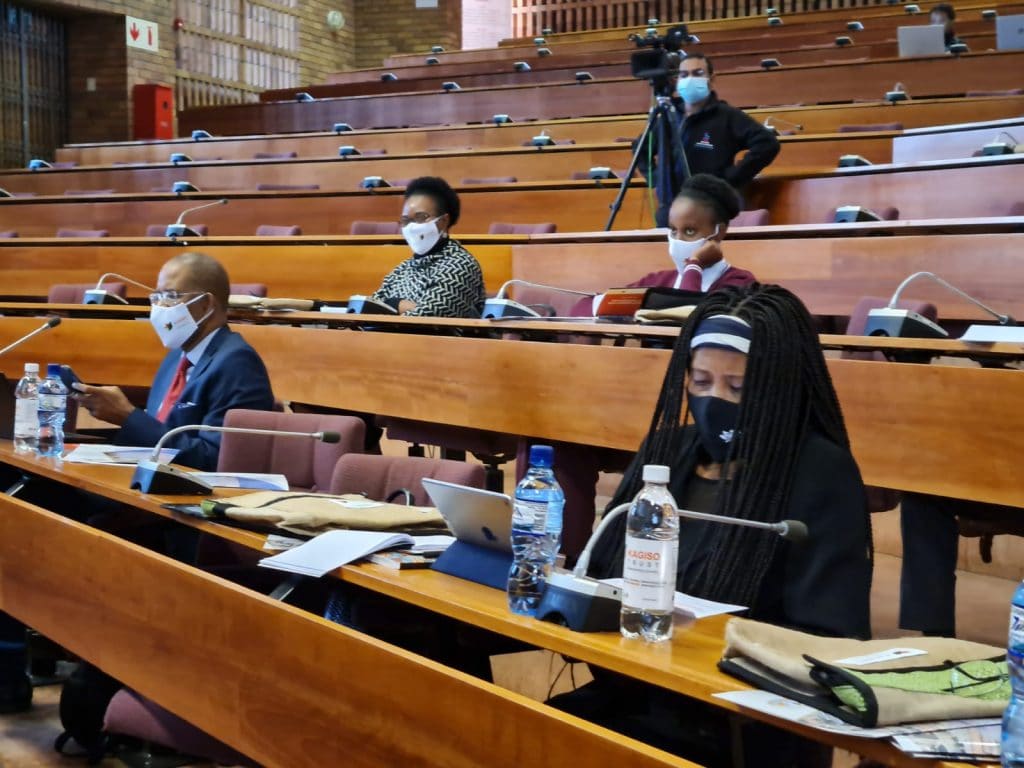
The inaugural Kagiso Trust Mathematics Symposium, titled “Mathematics for the 21st century and beyond: Improving mathematics teaching and learning”, held in May at the University of Limpopo heard that the way mathematics is taught, learnt and understood is evolving. Teachers remain the central element of the education cycle in an ever-changing world, and there is a need for their skills and understanding to similarly evolve in a holistic and innovate manner to overcome the stigma that it is a “difficult” subject.
Educators, mathematics professors and the learner with the highest marks in mathematics in South Africa in 2020 told the symposium, hosted both physically and virtually, of how learners could be made to embrace mathematics as not only part of their school curriculum, but as an essential part of their lives in the age of the Fourth Industrial Revolution.
Mathematics education in South Africa is regarded as poor, with a decline in the number of grade 12 learners writing and passing the subject over the last few years, particularly in rural and disadvantaged areas. This need not be so, speakers at the symposium said. The methods and practice of teaching, the difference between teaching and learning, the need for education in mother tongues, growing teacher capability, teacher education and rethinking how mathematics is taught and perceived was required.
“As teachers and parents we have this stigma of saying this subject is difficult, which is not the case,” said Dr Khangelani Sibiya, who was named the 2019 Global Teacher of the year. He uses creative strategies to improve the teaching and learning of mathematics, bringing in the elements of song, physical demonstration, sport and, perhaps most importantly, career guidance, to help learners embrace the subject.
“What I do when I teach, is I get the learners to write their choices for their careers. I allow them to go up to three choices and then we discuss requirements. If one wants to be a doctor, we must discuss on the first day what levels in what subjects you need to do that. If you want to be a doctor, you need an A in mathematics. This assists them when they are studying so they know what they must achieve to realise their goals,” said Sibiya.


He works mathematics principles into popular songs and shows learners that mathematics is a part of everything they do, from how they stand to how they communicate. He uses fashionable youth hand greetings to show them the concepts of parallel and perpendicular.
“I relate my teaching to soccer. The sign for Mamelodi Sundowns, for example, is a seven. What angle is there, the 90 degrees. From that I can apply Pythagoras theory. The sign of Orlando Pirates is crossed arms. There is mathematics there,” said Sibiya.
Dr Kabelo Chuene, the Professor of Mathematics at the University of Limpopo, said that there was a gap between teachers teaching and learners learning. If a learner gives a wrong answer, for example, that should be a trigger to help with understanding. Teaching is not about performance and results but understanding and having the skills to ensure learners are actually learning. She also believed curricula had to be revised in such a way that they address the skills needed for 4IR.
“Has pedagogy (the practice and method of teaching) evolved? Yes, and it will continue to do so,” said Chuene. “We don’t study the thing we do (teach). We need to analyse what happened during class and reflect on that. Do we teach teachers that analysis is important and incorporate it into our programmes? If we don’t, how do they improve? We need teachers who notice their learners. Wrong answers tell you what they are understanding and what they are not.”
Dr Mercy Kazima, professor of Mathematics Education at the University of Malawi, believes effective mathematics education requires a general mathematics knowledge combined with teaching methods: “Some focus on teaching and some on mathematics, sometimes letting down the knowledge of each other. It needs a balance of both. Effective teaching and learning depends on factors that include teacher, language, resources, class size, etc. The teacher is the most important factor.
Mother tongue language, particularly in a country such as South Africa with 11 official languages, was a hurdle, said Kazima. “Learning in English can present problems to learners. Struggling to understand the language cuts off access to the mathematics. Use language as a resource to promote learning by code switching, using both languages. Talk to children in their language. Encouraging learners to discuss and ask questions in their mother tongue instead of in English.”
For Daniel Gouws, who was the top performing grade 12 learner in mathematics in 2020, teachers and mentors helped him during a year disrupted by the pandemic. “Good teachers, who encouraged my curiosity and motivation, their passion fuelled my passion,” said Gouws, who said the attraction of mathematics for him was the process of solving a problem. “It’s the satisfaction of a job well done. One step and another step. It doesn’t really matter if you get a right or a wrong answer, it’s about going through the processes.”
His advice to learners when it comes to mathematics: “Understand the fundamental principles, they are the building blocks. Paying attention in class is easier than struggling through text books on your own. Lessons give you an audio and visual presentation, and you can ask questions. Try and understand how the method works, rather than memorising it.
Homework is where you get the practice on the method.” And, finally, “Celebrate the small successes. If you solve a step, go outside, have a run, jump up and down. Do something different. Mathematics is useful in your day-to-day life..”
Ms Mankone Ntsaba, Chairperson of the Kagiso Trust said, “The world, Africa and South Africa have currently got a number of problems. At Kagiso Trust we try to approach the societal challenges with like-minded solutions. We can take old solutions, re-think them, and re-package them in order to promote new solutions that are innovative in solving societal problems.
“Mathematics is not about solving ‘X’. It is about dealing with societal challenges. Mathematics is beyond numbers. It is about creating solutions and bringing the principles and methods into our everyday. We want to develop skills, professional teachers that can assist in producing members of society that can then solve socio-economic challenges.”
After the success of the first Kagiso Trust Mathematics Symposium, the Trust are planning more in various provinces in the future.