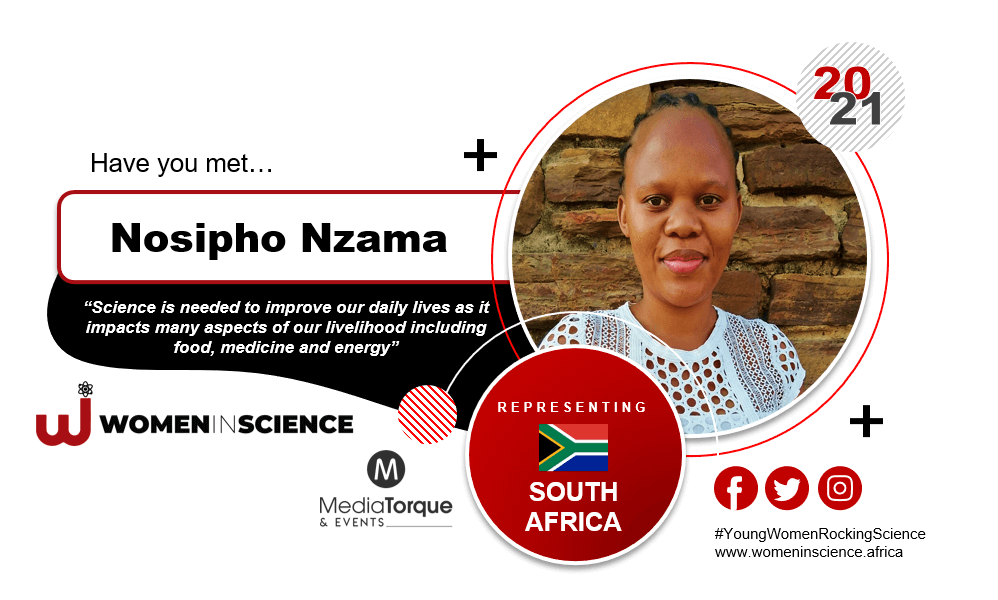
Nosipho Mercy Nzama describes herself as “an ambitious, patient and goal driven individual who is fully dedicated to accomplish her career goals”. Born 27 years ago in UMlazi Township in the heart of Durban, she is the first bon in a family of three girls. She was brought up single-handedly by her mother following the passing of her father while she was just eight years old.
Necsa sponsorship
She completed her matric in 2010 at Zwelibanzi High School where she passed with six distinctions. Her childhood dream was to become a pharmacist but as she obtained more information about other potential career paths, she started to develop interest in medicine and this led to her pursuing chemistry.
After completing her matric, Nzama was lucky enough to be granted a sponsorship by the South African Nuclear Energy Corp SOC Ltd (Necsa) to study for her undergraduate degree in chemistry at the University of Cape Town (UCT). She graduated in 2013 with a Bachelor of Science degree majoring in Chemistry and Biochemistry. The following year, she proceeded to study for her Honours degree in Chemistry, also at UCT.
Staying focused
Nzama says each qualification presented its own challenges but she stayed focused to ensure she accomplished her studies. While studying at UCT, she developed interest in the application of research methodologies and techniques to provide solutions to practical scientific problems.
In 2015, courtesy of Necsa again, Nzama was offered a 1-year graduate programme focusing on nuclear waste research. Her interest and passion to study further was insatiable for soon after the programme ended; she felt she needed to “sharpen her research skills further” and enrolled for master’s degree in applied science. Thus in 2020 Nzama obtained her Master of Science degree in Applied Science (Chemical Technology) from the University of Pretoria.
Early inspiration
Since 2017, she was employed as a scientist at Necsa, taking part in research and technology development. She says her love for science started at primary school where she was introduced to elements and the periodic table by her natural sciences teacher, Mr Sibusiso Maseko, who also doubled as the school principal and science teacher. She said Maseko has laid a foundation and provided inspiration for her to pursue the science stream. “He was very passionate about his teaching and went an extra mile by conducting extra lessons on the weekends,” she recalls fondly.
Why science is importance
“Science is needed to improve our daily lives as it impacts many aspects of our livelihood including food, medicine and energy. It can be used to provide solutions for everyday life through development of new products, processes and services and their improvement. Science is an important source of knowledge to explain how the universe works, how things function and their reason of importance. Overall, we can safely say that science has positively contributed to the advancement of the quality of life,” says Nzama.
Unprofessional conduct
She says she has encountered a considerable amount of unprofessional behaviour in her field. “I have experienced uncomfortable encounters where I was bullied, intimidated and had my work ethic and intelligence undermined. In other instances, I have had to navigate through uncomfortable conversations and comments mostly from male colleagues who expected more than a professional relationship. I still maintained a professional work ethic even during such encounters”, says Nzama.
Despite all these, she says she has “met and worked with a lot of people who were welcoming, supportive and professional”, adding that she continues to thrive in her career and also intend to make a mark in this field. Nzama says she is proud of all “the work I have done over the years”. But her major breakthrough came when she published her first article in 2019 titled ‘Batch studies on adsorptive removal of Co ions by CoTreat®’ with the Journal of Radio-analytical and Nuclear Chemistry.
Career highlights
Nzama says the article was part of a bigger research project aimed to design a purification scheme for irradiated uranium waste. She says part of the research project was also presented at the 2019 Young Chemists Symposium hosted by the South African Chemical Institute.
Professional tips and message
Her advice and message to young female scientist entering the field is that they should always keep in mind that “all dreams are valid, regardless of where you come from and your race. There is enough inspiration to get started from where you are”, she says. In addition:
- Do not allow yourself or anyone else to judge your capabilities based on your gender, do not limit yourself.
- Utilize all the resources you have at your disposal such as libraries, professors, experience colleagues, tutors, mentors and any field experts.
- Do not be afraid of failure, every scientific discovery or outcome is important whether the objectives are accomplished or not.
- Be bold and courageous to confidently tackle every new subject or position with complete willingness to learn and grow.
- Take charge of your dreams and do your part to make them possible.