Some of UNISA’S outstanding women were among the recipients of the Department of Science, Technology and Innovation’s (DSTI’s) 2025 South African Women in Science Awards (SAWiSA). They were honoured for excellence in STEM (science, technology, engineering and mathematics) and inspiring younger women. This year’s award marked its 20th anniversary under the theme “Unpacking STEM careers: “Her voice in science”.
CAPTION:
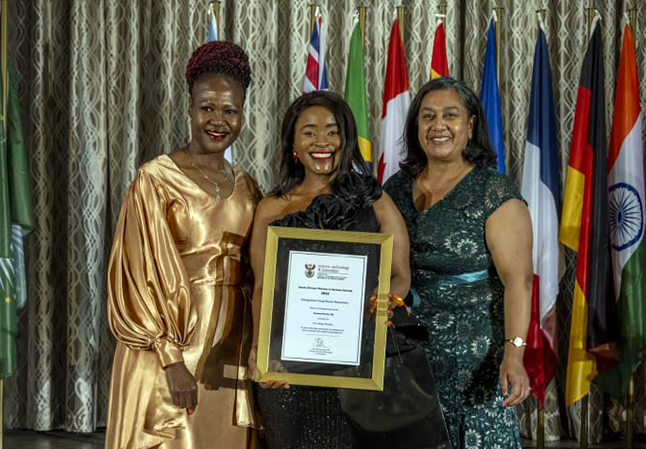
From left: Prof Patience Mthumzi-Kufa (College of Graduate Studies: UNISA and President: EWIS SA), Professor Tebogo Pilgrene Mashifana (SAWiSA recipient) and Prof Priscilla Baker (University of the Western Cape)
“These remarkable women continue to push boundaries of knowledge and innovation, enriching our understanding of the universe, society and of ourselves.” Their work demands exceptional talent and dedication,” – Nomalungelo Gina, Deputy Minister of Science, Technology and Innovation.
According to last year’s South African (SA) Science, Technology and Innovation Indicators Report, there is steady progress in advancing gender equity in the STEM field, with increased female representation across scientific publications. Enrolment and graduation of especially black women in STEM at higher education institutions has also increased.
Professor Zilungile (Lungi) Mkhize-Kitswana of Unisa’s College of Agriculture and Environmental Sciences (CAES), won the Distinguished Women Researcher Award: Public Engagement with Research. For her, this award is not only a personal achievement, but the result of the collective effort of teams, mentors, colleagues and young female students she mentored. “It validates decades of dedication to medical research, immunology and public health, including in neglected areas, such as tropical diseases. The award celebrates women breaking barriers in science, research and leadership. Such recognitions also encourage young women to pursue careers in this field and assure them that their contributions matter.”
Professor (Prof) Tebogo Pilgrene Mashifana of Unisa’s College of Science, Engineering and Technology (CSET), received the second runner-up award in the category Distinguished Young Women Researchers: Natural and Engineering Sciences. She says: “Being recognised for the SAWiSA highlights the impact of my research in the circular economy, where I focus on closing the loop and transforming linear systems into circular ones by turning waste into sustainable solutions which address environmental and societal challenges.”
According to Mashifana, the recognition also encourages her to keep pushing the boundaries of innovation and to inspire young women to perceive science as a tool for building resilient communities and a sustainable future. She notes: “Science is all around us and by embracing it and encouraging more women into STEMI (science, technology, engineering, mathematics, and innovation) we can find solutions to some of the most pressing challenges facing our communities.”
UNISA students Nolwazi Thabile Gazu and Nathma Samie, respectively studying towards their master’s degrees under CSET and the College of Human Sciences (CHS), received the DSTI-Ivy Matsepe-Casaburri Fellowships. Through these fellowships, DSTI aims to support postgraduate female researchers at critical stages in their academic journeys.
Congratulating the award recipients, Professor Les Labuschagne, Unisa’s Acting Vice-Principal of Research, Postgraduate Studies, Innovation and Commercialisation, remarked: “We are extremely proud of their achievements. It shows that UNISA delivers academics of a high calibre and that our transformation agenda of increasing the number of female academics is working.”