


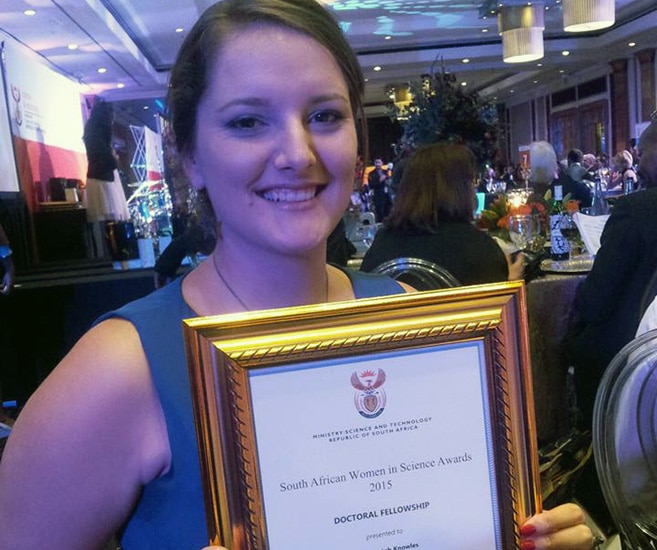
Dr Kenda Knowles, Rhodes University Research Fellow, is leading a team of international experts that has recently announced a comprehensive overview paper for the MeerKAT Galaxy Cluster Legacy Survey (MGCLS). The announcement was followed by a release of a trove of curated data that astronomers worldwide can tap into to address a variety of challenging questions relating to the formation and evolution of galaxies throughout the universe. Dr Mpati Ramatsoku, also a research fellow at the Rhodes University, contributed immensely to the seminal paper.
Thrilling experience
Titled “The MeerKAT Galaxy Cluster Legacy Survey. I. Survey Overview and Highlights”, the paper presents some novel and illuminating results. It has been accepted for publication in the Astronomy & Astrophysics journal. Dr Knowles said: “I’m very excited to see the impact MeerKAT can have in the global astronomy space and eager to see where the beautiful data will take us to better understand the many different components of our Universe.” She added that: “The complexity that is being revealed in radio galaxy structures, and how common this complexity actually seems to be, is very thrilling.”
Exceptional strengths
This first observatory-led survey uses the South African Radio Astronomy Observatory MeerKAT telescope located in the Karoo region of the Northern Cape province. The telescope’s exceptional strengths are capable of producing highly detailed and sensitive images of the radio emission from 115 clusters of galaxies. The observations, amounting to approximately 1000 hours of telescope time, were done in the year following the inauguration of MeerKAT in 2018. It took more than two years of work to convert the raw data into radio images utilising powerful computers, and to perform scientific analysis addressing a variety of topics.
Complex environments
Experts say the force of gravity has filled the expanding universe with objects extending over an astounding range of sizes, from comets that are 10 km across, to clusters of galaxies that can span 10 million light-years. These galaxy clusters are considered complex environments as they host thousands of galaxies, magnetic fields, and large regions – millions of light-years across – of extremely hot (millions of degrees) gas, electrons and protons moving close to the speed of light, and dark matter.
These so-called ‘relativistic’ electrons, spiral around the magnetic fields and produce the radio emission that MeerKAT can pick up. The MeerKAT, particularly when adding information from optical and infrared and X-ray telescopes, is exceptionally well-suited to studying the interplay between these components that determine the evolution of galaxy clusters – the largest structures in the universe held together by gravity.
Relativistic electrons
Although we live in an ocean of air, we can’t see it directly. However, if it’s filled with smoke or dust or water droplets, then suddenly we can see the gusts and swirls, whether they are a gentle breeze or an approaching tornado. Similarly, the motions of the X-ray-glowing plasma in galaxy clusters are usually hidden from us. Radio emission from the sprinkling of relativistic electrons in this plasma can uncover the dramatic storms in clusters, stirred up when clusters collide with each other, or when jets of material spew out of supermassive black holes in the centres of galaxies.
Radio galaxies
The MGCLS paper presents more than 50 newly discovered such patches of emission. Some of them we can understand, and others remain a mystery, awaiting advances in our understanding of the physical behaviour of cluster plasmas. Some examples are associated with the bright emission from so-called ‘radio galaxies,’ powered by the jets of supermassive black holes. Others, say the experts, are isolated features, illuminating winds and intergalactic shock wavesin the surrounding plasma. Other types of science enriched by the MGCLS include the regulation of star formation in galaxies, the physical processes of jet interactions, the study of faint cooler hydrogen gas – the fuel of stars – in various environments, and yet unknown investigations to be facilitated by serendipitous discoveries.
Serendipitous discovery
The MGCLS has produced detailed images of the extremely faint radio sky while surveying a substantial volume of space. “That’s what’s already enabled us to serendipitously discover rare kinds of galaxies, interactions, and diffuse features of radio emission, many of them quite beautiful,” said Dr Knowles adding, this is only the beginning.
Several additional studies delving more deeply into some of the initial discoveries are already underway by members of the MGCLS team. Beyond that, the richness of the science resulting from the MGCLS is expected to grow over the coming years, as astronomers worldwide download the data from the SARAO MeerKAT archive and probe it to answer their questions.


