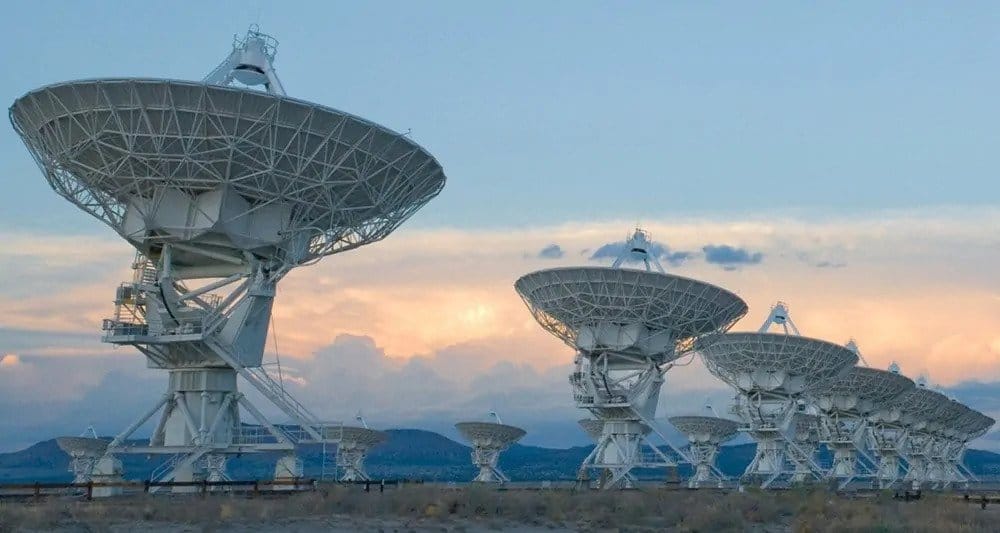
The SKA Observatory (SKAO) has on Thursday signed agreements with the governments of Australia and South Africa to host its telescopes and associated infrastructures. The signing formalises and sets in motion arrangements for the construction and operation of the SKA telescopes in the two host countries. It was signed at the SKAO Global headquarters located at Jodrell Bank near Manchester in the UK.
Unanimous approval
The Host Country Agreements (HCAs) were signed during the 4th meeting of the SKAO council, the Observatory’s governing body. SKAO director-general Professor Philip Diamond, Australia’s David Fredericks, secretary of the department of industry, science energy and resources, and South Africa’s Dr Phil Mjwara, director-general of the department of science and innovation, signed the agreements. According to a statement issued by the parties, the signing ceremony followed unanimous approval of the agreements by the seven member states represented at the council.
Smooth progress
Said Prof. Philip Diamond: “I am very pleased that we have finalised these agreements, which enable us to progress smoothly into the deployment of SKAO resources into Australia and South Africa and the construction phase of the SKA telescopes.” He also thanked both the Australian and the South African departments of science, technology and innovation for their involvement in the process.
Dr Lewis Ball, SKAO’s director of operations expressed excitement and relief for reaching this milestone. “Negotiating these agreements has been a complex process involving many people over a number of years but to now have them signed is a really important step in the delivery of the project, and the collaborative attitude of all involved sets us up well for this next, critical stage,” said Dr Ball.
Rights and responsibilities
The documents outline the rights and responsibilities of each party regarding the sites, assets and infrastructure required to build and operate the SKA telescopes. Among other elements, this includes: the respective governments’ obligation to provide radio frequency interference protection for the SKA telescope sites, the SKAO’s obligation to ensure that its operations meet or exceed local and national health, safety and environmental laws.
Land use agreements
The laws and obligations also cover the observatory’s use of infrastructure such as existing airstrips and fibre links. In addition, they have to take into account some of the sensibilities in the areas where the telescopes would be based. For instance, the Australian HCA recognises that an Indigenous Land Use Agreement with the Wajarri Yamatji – the traditional owners of Australia’s SKA site – has to be established before construction begins at that site. In South Africa, the HCA includes details on the incorporation of the 64-dish MeerKAT radio telescope into the SKA-Mid array, which will form an in-kind contribution by South Africa to the Observatory.
Technology spinoffs
Mr David Fredericks said Australia has “scientific and industrial capabilities, and wide open spaces position it ideally to host a project of this magnitude.” He said they will ensure technology spinoffs from the design of the telescopes will filter into everyday life and benefit society, adding “The Australian Government is proud to be working closely with the Wajarri Yamatji to realise this once-in-a-generation project on their traditional lands,” said Mr Fredicks.
Socio-economic benefits
Said Dr Phil Mjwara: “South Africa welcomes the signing of the hosting agreement as this paves the way for the construction of the SKA telescope in the country.” He added that: “This will bring enormous socio-economic benefits that will result in job-creation, industry development and skills development through our participation in this mega-infrastructure project.”
Four facilities
The SKAO will have operations at four separate facilities in each country and these will encompass:
- a remotely-located telescope array
- an Engineering Operations Centre to support the day-to-day maintenance and reliable physical operation of the telescope
- a Science Operations Centre from which the scientific programme of observations using the telescope will be run
- a Science Processing Centre where a supercomputer will process the data acquired by the telescope to produce data products for use by astronomers from the Member countries and around the world
- Both the Engineering Operations Centre and the Science Operations Centre will be provided by SKAO’s partner institutes, Australia’s national science agency CSIRO and the South African Radio Astronomy Observatory (SARAO) in South Africa on behalf of their governments, and made available to the SKAO.
Primary interface
The SKA member countries plan to also operate a network of ‘SKA Regional Centres’ that will provide the primary interface between the SKAO and the scientists who will use it. The scope of both agreements covers the entire projected lifespan of the SKAO’s telescopes, right up to and including decommissioning and restoration of the two sites.